White Noise for Baby Sleep: What Parents Need to Know
If you have ever stood in a baby aisle staring at a wall of white noise machines, wondering which one is worth it or whether you need one at all, you are not alone. White noise is one of the most commonly recommended infant sleep tools, and also one of the most misunderstood.
Here is what I tell families: white noise can be a genuinely useful part of a healthy sleep environment. It doesn’t replace the need for strong sleep skill and the right rhythm in the day, but it is a great cue and tool for children of all ages. The goal of this guide is to help you understand how it works, how to use it safely, and whether it is right for your family.
What Is White Noise and Why Does It Help?
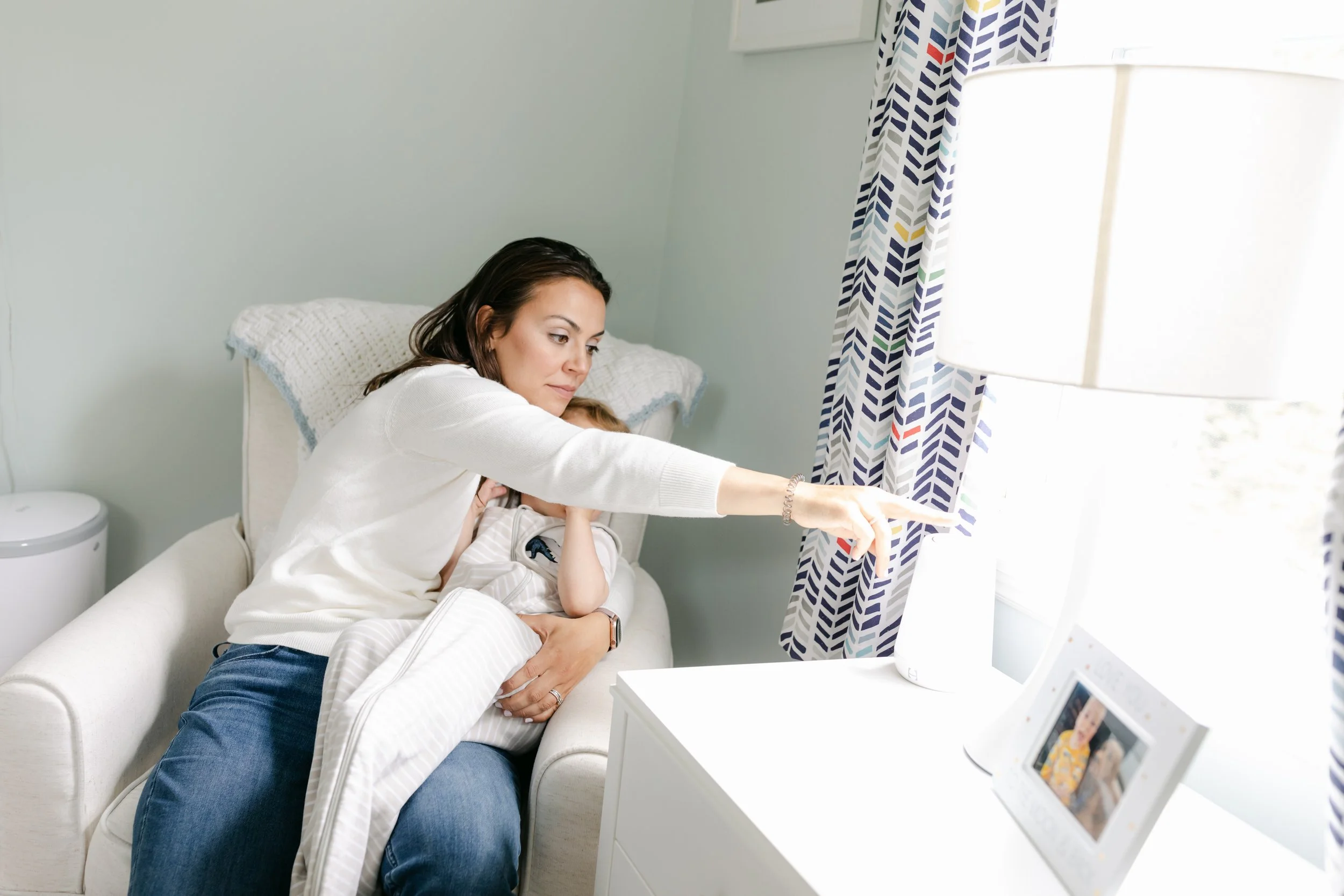
White noise is a consistent, steady sound that spans all frequencies simultaneously. In the context of sleep, it works in three ways. First, it creates an acoustic buffer that masks sudden environmental sounds like a dog barking, a sibling calling out, or a door closing, which might otherwise startle and rouse a sleeping baby. Second, research shows that the womb environment is surprisingly loud, roughly equivalent to a running vacuum cleaner, so familiar steady sound can be genuinely calming for newborns in particular. Lastly, infants, and really children of all ages, thrive on cues and using white noise to signal it’s time to sleep is extremely effective.
White noise is not magic. It does not put babies to sleep on its own. But in the right context, it supports a well-set-up sleep space and can help a baby fall asleep more easily and stay asleep longer by creating a more consistent environment.
Updated Volume Guidance: How Loud Is Safe?
This is one of the most important updates to this topic, and I want to be direct about it. The American Academy of Pediatrics (AAP) recommends keeping white noise machines at or below 50 decibels when measured at the baby's ear level, which is roughly the volume of a quiet conversation. Some machines ship with default settings that exceed this threshold, which is why both placement and volume control matter.
A simple rule of thumb: if you have to raise your voice to talk over the white noise, it is too loud. A free decibel meter app on your smartphone can give you a quick reading if you want to verify the level. Consistent exposure to sound above 85 decibels carries a risk of noise-induced hearing loss, so the lower end of the range is always the safer choice.
TIP: Test your white noise volume with a free decibel app before leaving it on all night. Aim for 50 dB or below measured at the level of your baby's sleep space.
How Far Should the Machine Be From the Sleep Space?
Placement matters as much as volume, and the two work together. The AAP recommends keeping white noise machines at least 7 feet from the infant's sleep space. Positioning the machine in the corner of the room or near the door, rather than directly next to the crib, allows sound to fill the room more evenly while keeping direct exposure at a safe level.
If you are working with a smaller room, compensate by lowering the volume. For a full look at how to set up a sleep environment that works, our safe sleep spaces guide covers the complete picture.
White Noise as a Sleep Prop vs. a Sleep Cue: Understanding the Difference
One of the most common questions I get about white noise is whether it creates a dependency. The answer depends less on the white noise itself and more on the conditions around it. Here is how to think through the distinction.
1. When white noise is simply a sleep cue
A sleep cue is any consistent signal that tells a child's brain it is time to rest. White noise functions as a healthy cue when a child falls asleep independently, meaning they go into their sleep space awake and settle on their own. In that case, the white noise is part of the environment, not a dependency.
2. When white noise becomes a prop
A sleep prop is anything a child relies on to fall asleep that they cannot recreate independently when they wake between sleep cycles overnight. White noise becomes a prop when a child is nursed, rocked, or held to sleep while it plays, and then wakes unable to resettle unless those conditions are recreated. For a closer look at how props develop and what to do about them, our sleep training myths and facts post addresses this in detail.
The distinction is not really about the white noise itself. It is about whether the child has independent sleep skills. White noise paired with independent sleep skills is a cue. White noise without independent sleep skills is one piece of a larger prop cycle.
REMEMBER: White noise does not cause a sleep prop dependency on its own. The prop is the condition under which the child learns to fall asleep, not the environmental backdrop.
Using a Machine vs. App vs. Fan
Parents ask this all the time, and the honest answer is that all three can work. Here is a breakdown of the practical differences so you can decide what fits your setup.
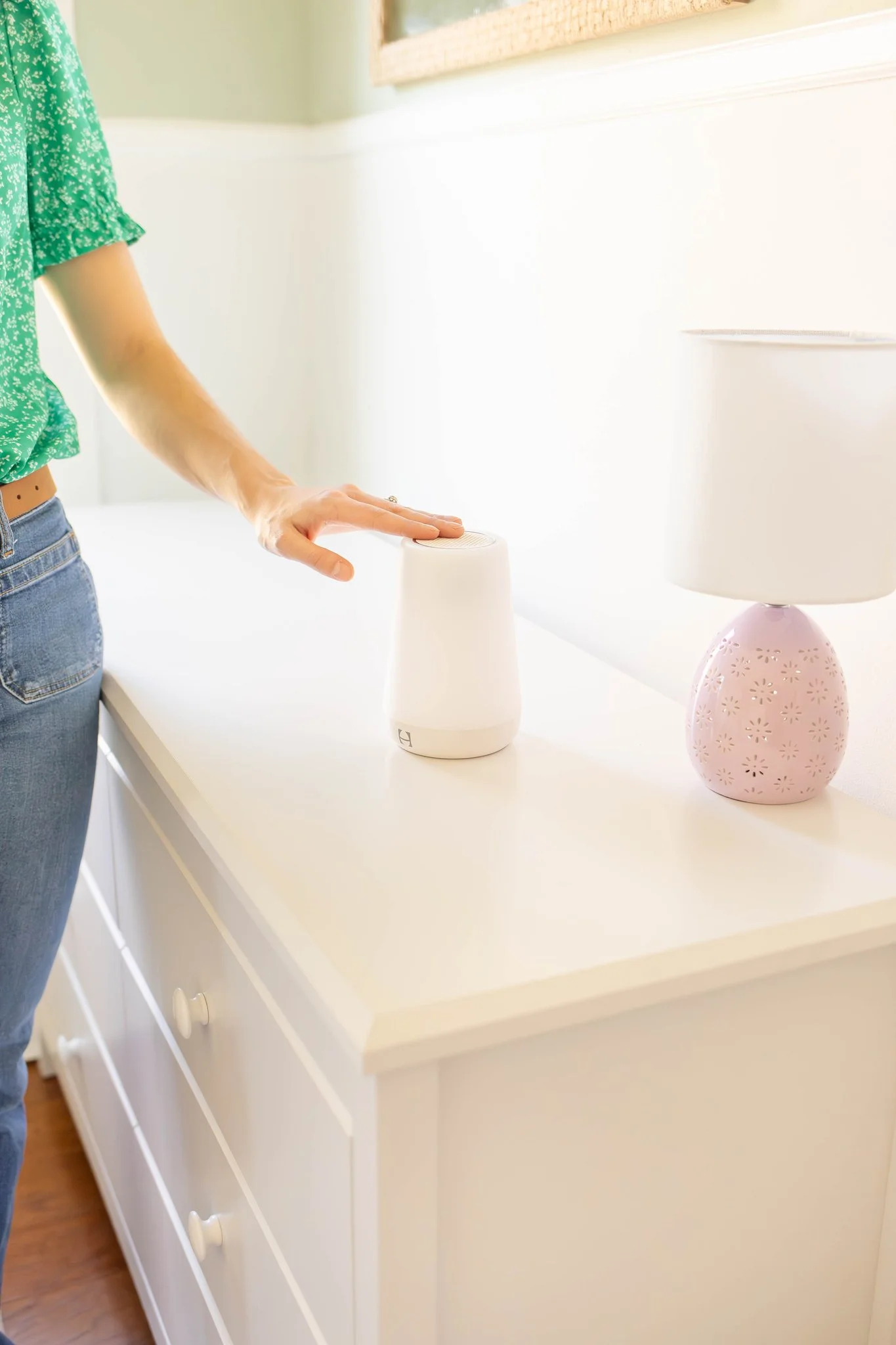
Dedicated white noise machine: Most consistent option with no battery drain risk. Many include volume control and timers. Best for everyday home use. Look for machines that include a true white noise setting, not just nature sounds, which have more variable frequencies. Some of my go-to recommendations are the Hatch Baby Sound Machine and Night Light, Yogasleep Hushh Portable Sound Machine, and Yogasleep Dohm Sound Machine, depending on your family's needs and budget.
White noise app on a phone or tablet: Convenient for travel and on-the-go naps. The main drawback is battery drain and the risk of notification sounds interrupting playback. If you use an app, put the device on airplane mode and keep it at a safe volume and distance.
Box fan or oscillating fan: An effective, low-cost option. Fans produce consistent broadband sound similar to white noise. Make sure the fan is not pointed directly at the baby and is not a safety hazard in the sleep space. Not ideal for portability.
How to Wean White Noise If You Want To
I am 45 years old and still use white noise at a safe level, so in my personal opinion you don’t need to wean. Many children use white noise throughout childhood without any issue, so it does not need to be eliminated. But if you want to wean, a gradual approach tends to work well. Here are the steps I recommend to families.
Reduce volume incrementally. Lower the volume by a small amount every few nights rather than turning it off abruptly.
Shorten the duration. If your machine has a timer, begin using it. Gradually reduce the timer window so the sound fades before the child enters deep sleep.
Introduce silence gradually. Once volume is low, try turning it off after the child is in a deep sleep phase. Over time, extend how early in the process you turn it off.
Expect an adjustment period. Some disruption for two to four nights is normal. Stay consistent and avoid reintroducing full volume after one rough night.
Common Myths About White Noise
A few misconceptions come up regularly when I talk to families about white noise. Here is what the research actually shows.
Myth 1: White noise will damage my baby's hearing
Not at safe volumes. The risk comes from prolonged exposure to high-volume sound. At 50 decibels or below, which is quieter than a normal conversation, white noise poses no known risk to developing hearing. The key is measuring and maintaining appropriate volume, not avoiding white noise altogether.
Myth 2: My child will never be able to sleep without it
White noise, like any environmental condition, is something most children can adapt to when the weaning process is gradual and consistent. Children who have strong independent sleep skills generalize those skills across environments more readily. If you are working toward that independence, our gradual sleep training method post walks through how to get there.
Myth 3: Nature sounds or soft music are the same as white noise
They are not, technically. True white noise is spectrally flat and covers all frequencies equally, which is why it effectively masks other sounds. Nature sounds like rain or ocean waves have variable frequency patterns that some children find soothing, but they do not mask environmental noise as consistently. Lullabies or music ongoing overnight is not recommended as it can interfere in your child getting the deep restorative sleep they need. Either can work as a sleep cue; they are just not interchangeable.
Final Thoughts
White noise is one of those topics that tends to generate more anxiety than it should. The research is reassuring, the tool is flexible, and the decision is genuinely yours to make. There is no right answer that applies to every family, and there is no version of this where you can get it badly wrong if you are paying attention to volume and placement.
What I hope you take away from this is simple: if white noise is working for your family, keep using it. If it is not serving you, you have a clear path to wean it. And if you are still trying to figure out where it fits in your bigger sleep picture, that is exactly what we are here to help with.
Book a complimentary consultation with our sleep team and we will look at the full picture together
Meg O'Leary is an Infant and Child Sleep Expert and the founder of A Restful Night. Based in Westchester County, NY, she leads a team of certified sleep coaches to provide virtual support to families across the US and around the world.