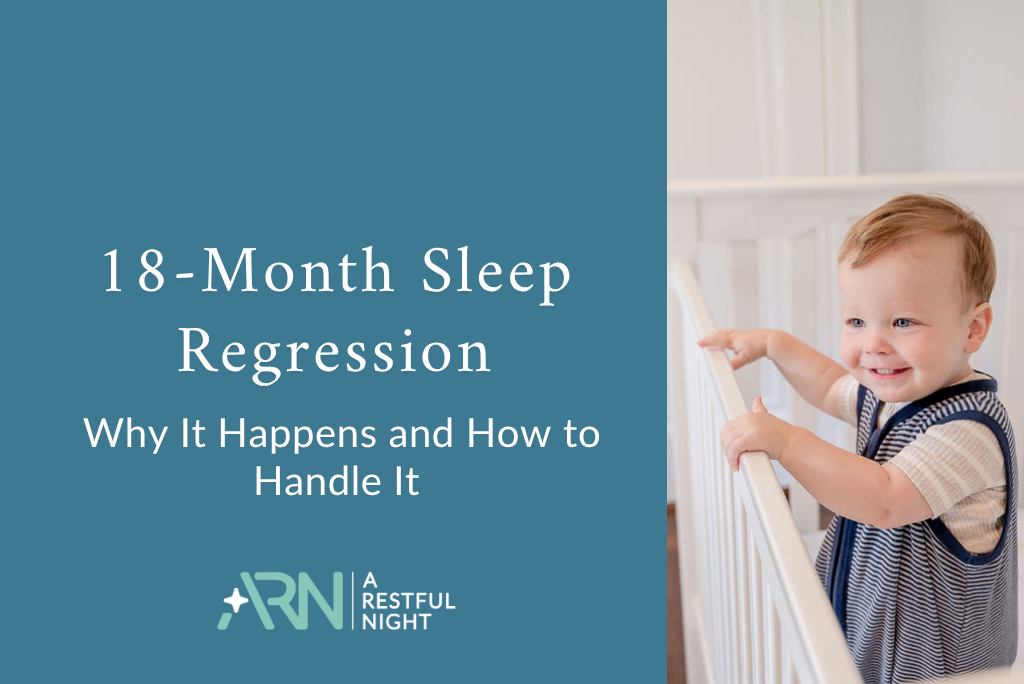
18-Month Sleep Regression: Why It Happens and How to Handle It
Eighteen months is a really fun age! Your child is walking, babbling, pointing at everything, and really developing into their own person. In the middle of all this development is also an increasing desire for control, a heightened awareness of separation and oftentimes frustration that comes along with wanting to communicate but not necessarily having the words yet. This trifecta often results in some major sleep disruptions that can feel more extreme than any other regression you’ve experienced.
I've been through this stage four times with my own children and countless times with the families we support and I’m laying it all out here in this blog!
What Is the 18 Month Sleep Regression?
The 18 month sleep regression is a stretch of disrupted sleep in a toddler who was previously sleeping well. It often shows up as new night wakings, bedtime protest, or nap refusal. It's typically driven by a combination of physical development, learned behavior patterns, and shifting sleep needs. Most regressions last about two to six weeks, but can last longer if you don’t know how to fix it!
Common signs include:
Fighting bedtime or naps, sometimes loudly
Standing, climbing, or practicing new skills in the crib
Calling you back in for one more hug, drink, or book
An 18 month old waking up at night after months of sleeping through
Strongly preferring one parent at bedtime, with big reactions when the other steps in
Why the 18 Month Old Sleep Regression Happens

In my experience, this toddler sleep regression rarely has a single cause. Like the other major sleep regressions, it's a mix of development, behavior, and a change in what your child's body needs. Here's how each piece comes into play.
1. Their Bodies Are Doing a Lot
By 18 months, most toddlers are walking confidently, and many are running, climbing, and trying to jump. That physical energy doesn't switch off at bedtime. Standing in the crib, cruising the rails, and testing whether a leg can make it over the side are all part of the package.
2. They Want More Control
Your child is becoming a person with opinions, and research on toddler development describes this age as a period of emerging independence. They want a say in who does bath, which pajamas go on, and whether bedtime is happening at all. That push for autonomy is healthy, but impulse control is still very much a work in progress. The combination tends to show up loudest at the end of the day.
3. They've Figured Out What Gets a Reaction
This is the piece I spend the most time on with families. Toddlers are quick to connect cause and effect, and at this age most bedtime behavior serves one of three purposes:
Access: getting more of you, or more of something, like an extra book
Escape: avoiding a transition, like resisting bath because bath means bedtime is next
Attention: calling you back for one more hug or a sip of water so they can see you again
In the moment, each of these feels like a legitimate need. Over time, if the request reliably works, it becomes the expectation and a pattern forms. Picture your parenting partner starting bathtime, your toddler melting down, and you stepping in to calm things. It's a completely loving response, and it also teaches your child that a meltdown brings you in. Repeat that for a week or two, and it can look a lot like a regression.
4. Their Sleep Needs Are Shifting
Your toddler should be on one nap by 18 months. At this age, we're generally aiming for about 13 hours of total sleep in a 24-hour period: 11 to 12 hours overnight, plus a midday nap of roughly 90 minutes to two hours. When the schedule hasn't caught up to those needs, sleep can unravel even when everything else is in place. If your child is still settling into one nap, the 2-to-1 nap transition is worth a look.
How to Handle the 18 Month Sleep Regression

Before changing anything, I always ask parents to work through three questions. Together, they'll tell you where to focus.
1. Can Your Child Fall Asleep Independently?
This is always my first question. If your toddler needs help falling asleep at the start of the nap or at bedtime, what feels like a regression is often a skill gap showing itself. Independent sleep skills are the foundation, and at this age, building them is very achievable. Families choose different approaches, from gradual methods to graduated extinction, based on what fits their values and their child.
2. Is the Nap the Right Length, at the Right Time?
Too much daytime sleep, or a nap that ends too late, means your child goes into the crib at bedtime less tired than they need to be. A toddler who isn't ready for sleep has more energy for calling you back in, standing, climbing, or waking early. Review wake time, nap start, nap length, and bedtime against your child's age. Our 18 month schedule lays it all out if you want a starting point.
3. How Are You Responding Outside the Crib?
What happens during the day shapes what happens at night. If whining reliably leads to being picked up, your child will use that same signal from the crib. That doesn't mean ignoring your child's needs. It means responding warmly to calm communication and keeping your responses predictable, so the crib isn't the one place where the rules suddenly change.
REMEMBER: Consistency across caregivers matters. Whatever response you choose, it works best when every adult handles it the same way.
Protect the "Stations of Safety"
I describe the car seat, stroller, high chair, and crib to parents as stations of safety. In your toddler's eyes, they're all the same kind of space. When climbing in and out of the high chair or stroller becomes a game during the day, it signals that climbing out is allowed, and the crib is next on the list. This boundary only matters more heading into the 2-year regression.
Crib climbing can start as early as 18 months. If your child is already climbing out, treat it as a safety cue to plan the move to a bed, regardless of age. Our Crib to Bed Transition Course walks you through it step by step.
Introduce Visual and Verbal Cues
This is a great age to start building simple, predictable sleep cues. A consistent phrase at lights out, paired with a light that changes color when it's time to wake, gives your toddler a signal they can learn long before they can tell time. An ok-to-wake clock like the Hatch is a good place to start.
Final Thoughts
The 18 month sleep regression can feel like it came out of nowhere, but it almost always has an explanation you can work with. Check the skill, check the schedule, and look honestly at the patterns forming outside the crib. In my experience, most families find their answer in one of those three places.
This stage is temporary, and the confidence your child builds by learning to settle on their own lasts far longer than the regression does.
If you've worked through those questions and you're still not sure where to start, book a complimentary consultation with A Restful Night. We'll look at the full picture together and build a plan that fits your family.
Meg O'Leary is an Infant and Child Sleep Expert and the founder of A Restful Night. Based in Westchester County, NY, she leads a team of certified sleep coaches to provide virtual support to families across the US and around the world.