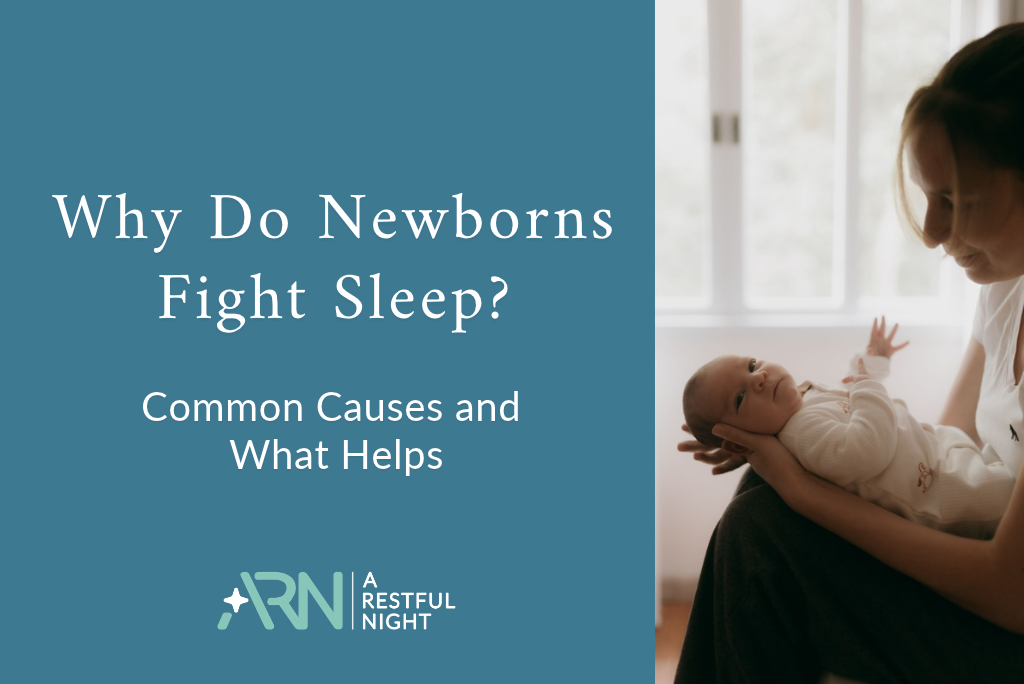
Your baby is yawning, rubbing their face, and clearly exhausted. Yet the moment you try to help them sleep, they arch, cry, and protest as if sleep is the last thing they want. You feel like you are doing all the right things, but nothing is working.
This challenge is very common and one that especially hits first time parents hard because it’s mind-blowing how your baby can seemingly stay awake for 3-4 hours and then still fight sleep.
Why Do Newborns Fight Sleep?

Newborns fight sleep most often because they're overtired, under tired, hungry, uncomfortable, or overstimulated, so it’s no wonder you are confused! A baby who won’t sleep is usually going to end up getting more assistance which can lead to even more overstimulation.
The way your baby fights sleep is often your best clue to the cause of why they are fighting it. A baby who cries harder the more you rock them is telling you something different than one who drifts off and startles awake five minutes later. The sections below walk through what each pattern tends to mean.
Common Reasons Your Newborn Is Fighting Sleep
Most sleep fighting in the newborn weeks comes down to one of six causes. Each one has its own signs and solves so it's worth getting familiar with all of them.
1. They've Been Awake Too Long
Most newborns can only handle wake windows of 45 to 90 minutes, and that includes feeding and diaper changes. Younger newborns sit at the shorter end of that range. When a baby goes past their window, they often become overtired: wired and frantic rather than drowsy, crying harder the more you try to soothe them.
The fix is to start winding down at the first sleepy cue, not the last. Yawning, glazed eyes, and turning away from faces all mean it's time. For very young newborns, that often means beginning the wind-down around 45 minutes after they wake. When you see this cue, start your nap routine: a diaper change, swaddle, white noise and a familiar song to signal it’s time to sleep.
2. They Aren't Tired Enough
This one surprises parents. Overtiredness gets a lot of blame, but a baby who just woke from a long nap may simply not have built enough sleep pressure to fall asleep again. These babies are usually alert and content, just uninterested in sleeping.
It's especially common with day-night confusion, when a baby does most of their sleeping during the day and arrives at bedtime wide awake. Keep daytime bright and engaging and nights dim, quiet, and boring. During the day, we typically encourage parents to wake a newborn at about the 90 minute mark nap so feeds don't get skipped and so we can preserve those long stretches of sleep for overnight..
3. They're Still Hungry

Newborns often fall asleep partway through a feed, then wake 20 minutes later still hungry.This is a two-fold problem. 1. your baby may not be getting a full feed and 2. The micronap mid-feed is going to impact their ability to fall asleep for the next nap. If your baby roots, sucks on their hands, or wakes shortly after you set them down, hunger may be the culprit. Many babies also cluster feed in the evening, wanting to eat every hour or so for a stretch, which can look a lot like fighting sleep.
Working toward full, focused feeds helps. A diaper change, undressing to the diaper, or switching sides can keep a sleepy baby awake long enough to finish. Newborns typically eat every two to three hours, whether breastfed or formula-fed, and your pediatrician should weigh in before you change how often your baby eats.
4. Gas or Physical Discomfort
Trapped gas, a wet diaper, or being too warm can all keep a baby from settling. A baby who pulls their legs up, grunts, or squirms when they should be drifting off is often uncomfortable rather than resistant.
Burp during and after feeds, and give your baby a few upright minutes before laying them down. Slowly bicycling their legs can help move gas along, and one light layer more than you'd wear keeps most babies comfortable. If your baby regularly arches, cries, or spits up a lot after feeds, talk to your pediatrician, since reflux can make lying flat uncomfortable.
5. The Startle Reflex Keeps Waking Them
The Moro reflex, or startle reflex, makes a newborn's arms fling out with any sudden movement or change in position. If your baby falls asleep, then jolts awake with arms flung wide, this is usually why. It's especially likely during the bassinet transfer, when your baby moves from your arms to a flat mattress.
A snug swaddle contains the reflex and recreates some of the containment your baby feels in your arms. Stop swaddling at the first sign your baby is attempting to roll, usually around 10 1- 12 weeks, sometimes sooner
6. Too Much Stimulation
Visitors, a busy room, bright lights, or a TV on in the background can be a lot for a newborn's brain to process. An overstimulated baby often turns away, gets jerky, and cries harder the more you try to engage. Rocking, bouncing or nervous energy can also lead to a newborn fighting sleep.
The fix is usually to do less, not more. Move somewhere dim and quiet, use fewer voices and less bouncing, and let steady white noise soften household sound. Many babies settle within minutes once the input drops.
Don't underestimate the power of your energy
I'm not adding a 7th reason but if I were it would be that a parent's energy may be creating more crying. This is hard to write as I've been a nervous first time mom and know how it can feel when all you want to do is help your child settle, but sometimes the tenseness of your energy or body can transfer to your baby. So don't hesitate to put your baby down, or decide to go for a walk or tap into a family member or partner to help. Sometimes we need a break too!
When to Call Your Pediatrician
Most sleep fighting is a normal part of the newborn stage, but sometimes it points to something that needs a closer look. Call your pediatrician if your baby:
Has crying that sounds high-pitched or very different from usual, or can't be consoled
Is feeding poorly or having fewer wet diapers
Has a rectal temperature of 100.4°F or higher and is under 3 months old (call right away)
Vomits forcefully or seems to be in pain after feeds
Is congested enough that feeding or breathing seems harder
Don't give any medication without your pediatrician's approval. And trust your instincts too. You know your baby better than anyone.
Final Thoughts
A newborn fighting sleep is one of the most exhausting parts of early parenthood, and it's also one of the most temporary. As your baby's nervous system matures and you learn their patterns, these moments get shorter and less frequent.
You don't need to get it right every time. You just need to keep reading your baby and adjusting.
If the newborn weeks feel harder than you expected, you don't have to sort through it alone. Book a complimentary consultation with A Restful Night, and we'll look at the full picture together and give you a clear, realistic next step.
Meg O'Leary is an Infant and Child Sleep Expert and the founder of A Restful Night. Based in Westchester County, NY, she leads a team of certified sleep coaches to provide virtual support to families across the US and around the world.