How to Get Dad Involved in the Bedtime Routine
I am a mom of four and one of the things I have always been intentional about in my own house is this: anyone should be able to put my kids to sleep. My husband, Chris, has been doing bedtime with confidence for years, and I will not pretend that happened on its own.
Getting a parenting partner meaningfully involved in sleep routines takes some thought, some patience, and occasionally some stepping back on the part of the parent who has been carrying the load. But it is one of the most worthwhile investments you can make for your child's sleep, your partner's confidence, and your own ability to take a breath at the end of the day.
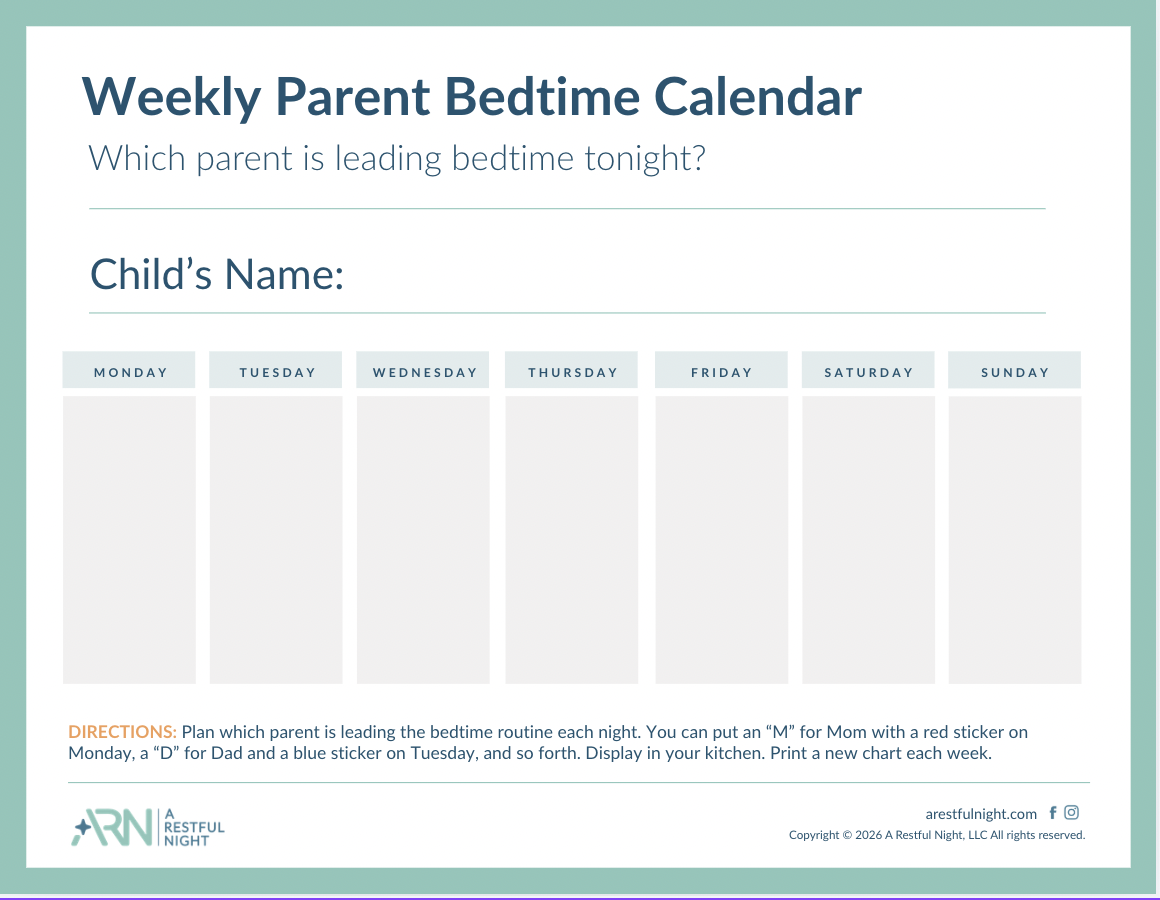
Ready to take the guesswork out of bedtime?
Download our free parent bedtime calendar to help map out who is in charge of bedtime each day of the week. This is handy visual tool that helps your child (and your parenting partner) know what to expect!
Getting Dad Involved in Bed Time
When only one parent handles sleep consistently, children, especially after 6 months, begin to register the pattern. Babies are remarkably good at recognizing cause and effect. If mom always comes at night, that becomes what baby expects and pursues. It is not manipulation; it is pattern recognition. The good news is: patterns can be changed.
Sharing bedtime duties also protects against the burnout that comes from being the sole sleep parent. A consistent, predictable bedtime routine is one of the best foundations for making this work. If yours needs a refresh, our kids bedtime routine tips post is a great starting point. Children who are comfortable with multiple caregivers at sleep time tend to be more adaptable sleepers overall.
Start by Identifying What is Getting in the Way
1. Your partner is not sure how to do BEDTIME
Confidence is often the real barrier, not willingness. A parenting partner who has not been deeply involved in the sleep routine may feel uncertain about the steps, the cues, or whether they are doing it right. This is normal, and it is fixable with practice and positive reinforcement.
2. Your partner is willing but has not had the opportunity
Some families fall into a pattern where one parent just does bedtime, not because of any deliberate decision, but because of logistics, breastfeeding, schedules, or habit. If that is the case, the path forward is simply creating the opportunity and then stepping back fully to let it happen.
3. You are having a hard time letting go
This one is worth sitting with honestly. It can be genuinely hard to watch someone do the routine differently than you do. But a bedtime with a slightly different book order or pajama sequence is still a good bedtime. Holding on to control, even with the best intentions, sends your child the signal that only you can meet this need. That is a harder pattern to break later.
TIP: Your child picks up on your reactions. If you swoop in every time your partner tries and the baby fusses, you are signaling to both of them that it is not going to work. Trust takes time to build on all sides.
Practical Ways to Build Dad Into the Routine
Once you have identified the barrier, the good news is that there are concrete steps that move things forward. Here is what tends to work well across different family setups.

1. Start with something low-pressure
You do not need to hand over a full bedtime routine on night one. Start with one piece of it. Have your partner put on pajamas while you do the bath. Have them read the book after you have fed your baby. Give them the daytime responsibilities first: a diaper change, a bottle, pushing the stroller, before tackling the overnight duty. Low-stakes repetition builds confidence faster than trial by fire.
2. Use sleep training as a natural entry point
If you are working on building independent sleep skills, this is a natural moment to bring your partner in. For nursing parents especially, having a parenting partner take over the getting to sleep step, by holding or rocking rather than nursing to sleep, can be a meaningful first move toward gradual sleep training. Our post on breastfeeding and sleep training addresses this transition in detail and is worth a read if you are navigating both at once.
3. Try a bedtime chart for toddlers
For families with toddlers ages 1 to 3, a visual bedtime chart that maps out the week ahead with which parent is responsible for bedtime each night can be a surprisingly effective tool. Toddlers do well with predictability and visual anchors. Knowing in advance whose night it is reduces negotiation at the moment for everyone involved. If bedtime has become a consistent battle before you even get to the handoff, our toddler bedtime battles post covers strategies for getting that under control first.
4. Give genuine, positive feedback
If your partner is new to the routine and the baby fussed for 10 minutes before settling but did settle, that is a win. Name it. If your toddler only asked for one extra cup of water instead of five, celebrate that. Confidence grows with acknowledgment, and a partner who feels like they are succeeding is a partner who keeps showing up.
TIP: Avoid correcting in the moment. Save any feedback for a calm conversation later, and lead with what went well. A parenting partner who feels judged pulls back. One who feels capable leans in.
Navigating Parent Preference in Babies and Toddlers
Parent preference often shows up around the same time partners start getting more involved, and it can feel discouraging. Here is what is actually happening at each stage and how to respond without reinforcing it.
Babies 6 months and up
Around 6 months, many babies begin showing a clear preference for one parent, usually the primary caregiver. This is developmentally normal and connected to their growing awareness of patterns. What matters is that you do not unintentionally reinforce it.
If your baby reaches for you while your partner is holding them, resist the instinct to immediately take over. Let your partner hold through a brief fuss. The baby is not suffering; they are adjusting. Your calm confidence in your partner is part of what reassures the baby that everything is fine.
Toddlers ages 1 to 3
Toddler parent preference can be intense. A two-year-old who only wants mom at bedtime and protests when dad walks in is exhausting for everyone, including dad. Part of what drives this is that toddlers are still developing impulse control, which makes it hard for them to manage the frustration of not getting exactly what they want at that moment.
Have your partner do the small, routine things: tie the shoes, cut the waffles, do the bath. Hold through the protest rather than backing down. If one parent consistently rescues at the first sign of frustration, the toddler learns that protest gets them access to that parent. Staying the course, even for a few days, usually resets the pattern.
Common Misconceptions About Sharing Bedtime
A couple of beliefs tend to hold parents back from making this shift, and both are worth addressing directly.
Misconception 1: The baby will only bond with the bedtime parent
Bonding is not built in one routine. It is built across all the daily interactions: feeding, playing, comforting, reading, being present. Bedtime is one opportunity among many, and sharing it does not dilute anything.
Misconception 2: If they cry, it is not working
Protest is not failure. When a baby or toddler fusses for a parenting partner doing bedtime, they are communicating preference, not experiencing harm. Consistent, warm follow-through is what builds trust and adaptability over time.
Final Thoughts
Getting a parenting partner involved in the bedtime routine is one of the most practical things you can do for your family's long-term sleep health. It does not have to be perfect from night one, and it does not have to look exactly like the way you do it. What matters is that you start, stay consistent, and give it enough time to become the new normal.
In my house, the goal has always been that sleep does not depend on any one person. That kind of shared ownership gives everyone more freedom, and it gives your child something valuable too: the confidence that they are safe and cared for no matter who walks through the door at bedtime.
If you are ready to make this shift and want help building a plan that works for your whole family, book a complimentary consultation with A Restful Night.
Meg O'Leary is an Infant and Child Sleep Expert and the founder of A Restful Night. Based in Westchester County, NY, she leads a team of certified sleep coaches to provide virtual support to families across the US and around the world.