How to Build the Perfect Bedtime Routine: An Expert Sleep Consultant's 6 Step Guide
A solid bedtime routine is one of the most powerful tools you have as a parent. It sets the stage for a smooth transition to sleep, helps your child wind down after a busy day, and creates predictable moments of connection that both you and your little one can count on.
But not all bedtime routines are created equal. Some work like magic, while others feel like a nightly battle. Let's break down the six essential elements that transform an ordinary routine into one that actually works.

1. Timing
Timing isn't just about what time bedtime happens. It's about understanding your child's natural sleep windows and their age appropriate sleep needs.
Watch for sleep cues like eye rubbing, yawning, and clinginess. This is a sign to start your routine.
Use wake windows directionally to help time your bedtime A 6-month-old might only handle 2.5 hours of awake time before bedtime, while a 3-year-old can manage 5-6 hours.
Keep bedtime flexible based on the timing and quality of your child’s nap, ideally you want to prioritize 11 hours of sleep overnight
TIP: Avoid the urge to “tire them out” before bedtime.The key is to start before your child becomes overtired, when cortisol production can turn a peaceful routine into a struggle.
2. Structure and Predictability
Children thrive on predictability. When they know what comes next, they feel safe and secure, which is exactly the emotional state you want at bedtime.
Your routine should follow the same order every single night. For example: bath, brush teeth, pajamas, read two books, sing one song, lights out.
Aim for 20-40 minutes total for toddlers and preschoolers, and 15-30 minutes for babies (not including their milk feed).
While you might offer choices within the routine (which book to read, which pajamas to wear), the overall structure should remain non-negotiable.
TIP: Think of your bedtime routine as a well-worn path. The more times you walk the same path, the clearer and easier it becomes to follow.
3. Visual and Verbal Cues

Young children can't tell time, so they need other ways to understand that bedtime is approaching. Visual and verbal cues create clear signals that prepare their body and mind to wind down.
About 30-60 minutes before bedtime, start dimming lights throughout your home. Bright lights suppress melatonin production, so creating a darker environment helps your child's body prepare for sleep naturally.
Narrate what's happening using simple, consistent phrases: "It's almost time for sleep. First, we'll take a bath, then we'll put on pajamas, then we'll read books, and then it's time to sleep in your cozy bed."
For toddlers and older children, visual schedules with pictures showing each step can be incredibly helpful. An OK-to-Wake Clock can also serve as a powerful visual cue, teaching your child when it's time to sleep and when it's appropriate to start the day.
REMEMBER: Your energy is their guide. Stay calm and clear throughout the routine to help guide your child.
4. Minimal Transitions
Every transition is an opportunity for resistance or distraction. The fewer times you have to move your child from one place to another, the smoother your routine will be.
Try to do multiple steps in the same location before moving. For example, if your child's bedroom is upstairs, consider doing bath, pajamas, and teeth brushing all in the bathroom before heading to the bedroom for the final wind-down.
I’ll be honest, we aren’t a screen-free household! However, if your child has been watching TV or using a tablet, build in at least 30-60 minutes of screen-free time before bedtime. . The blue light and stimulating content make it much harder for children to settle.
A parent coming in and out of the routine is also a transition. Have one parent complete the bedtime routine each night from start to finish - and divide bedtime duties by day instead of by task.
TIP: This is especially true for toddlers: transitions create the opportunity for stalling, and stalling creates the opportunity for meltdowns. Minimizing transitions to maximize your routine’s effectiveness!
5. Emotional Connection

This might be the most underrated element of a successful bedtime routine. Children who feel emotionally connected and secure are far more willing to separate from you at bedtime.
Give your child your undivided attention during the bedtime routine. Put your phone away, make eye contact, and be fully present.For older toddlers and preschoolers, briefly discussing highlights from the day helps them process emotions before sleep.
Simple phrases like "I love you," or "I'll see you in the morning" provide comfort and security.
One moment of connection my children love: “list 3 things you’d like to dream about tonight.”
THOUGHT: It’s your responsibility as a parent to keep these moments of connection upbeat and brief. Lengthening the bedtime routine because you can’t bear to pull away from a snuggle (I know, it’s hard!) will undermine the work you’ve done to create consistency and clarity.
6. The Final Cue
Your routine needs a clear ending point that signals "this is it, sleep time is now." Without this final cue, children may keep asking for "just one more" book, song, or sip of water.
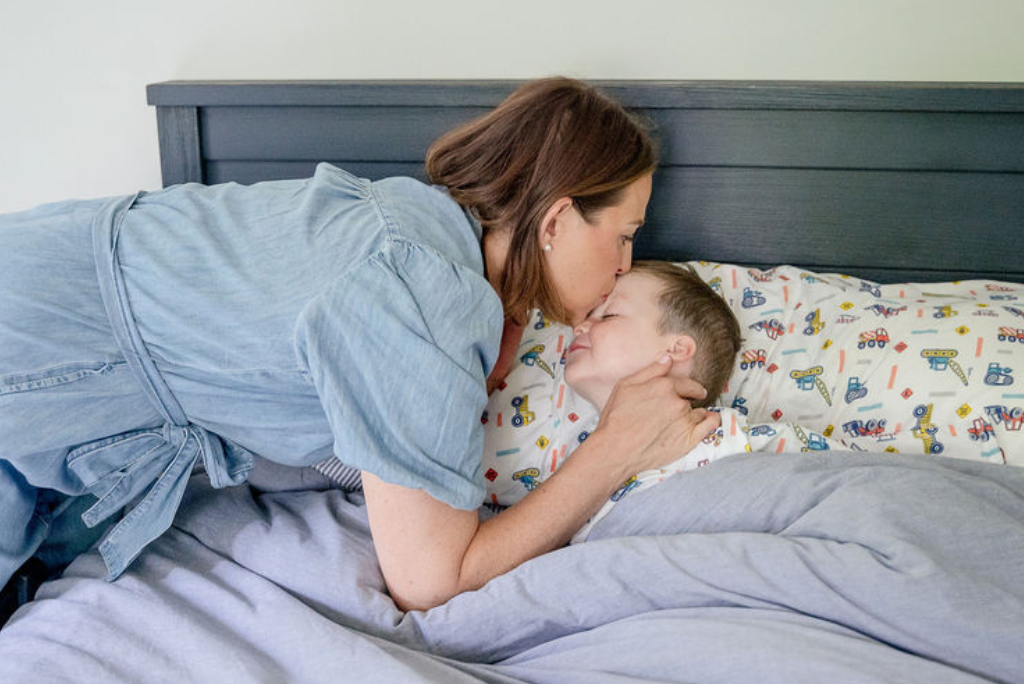
Choose a final step like a specific phrase ("Goodnight, I love you, see you in the morning"), turning on white noise, or giving a final kiss. Whatever you choose, it should be brief and consistent.
Once you deliver this final cue, you're done.
Your final cue should be delivered calmly and confidently, never with frustration.
Bedtime Routine Myths
Let's address two common misconceptions that often trip parents up when they're trying to establish a bedtime routine.
Myth: "My Child Should Be in Bed by 7:00 PM"
Truth: Bedtime should be flexible. This will lead to more regular wake ups in the morning. Bedtime range is dictated by what time you want your child to wake up and the overall quality of their day.
There's no magic bedtime that works for every child or every family. If your child consistently wakes at 6:00 AM and needs 11 hours of sleep, then a 7:00 PM bedtime makes sense. But if they naturally wake at 7:30 AM, pushing for a 7:00 PM bedtime might actually make things harder, especially if your toddler is napping!
Myth: "My Child Should Be Sleeping 12 Hours Overnight, 7:00 PM to 7:00 AM"
Truth: Sleep needs are calculated in a 24-hour period. Total Sleep = Naptime Sleep + Overnight Sleep.
Eleven hours overnight is the typical standard. As children get older (4 years old and up), sleep needs decrease and 10 hours is expected. Always prioritize overnight sleep.
If your toddler is taking a 2-hour nap during the day, expecting them to sleep 12 hours at night means you're asking for 14 hours of total sleep, which is likely more than they need. The key is to look at the full 24-hour picture and adjust your bedtime routine's start time accordingly.
Assess Your Child's Bedtime Routine
Now that you understand what makes a great bedtime routine, take a moment to evaluate what you're currently doing. Ask yourself these four questions:
1. Am I timing bedtime correctly? Think about your child's natural wake time and sleep needs. Are you starting the routine when your child shows sleep cues, or are you waiting until they're overtired?
2. Does my child's routine have a start, middle, and end? Can you clearly identify the beginning (perhaps dimming lights and starting bath time), the middle (pajamas and books), and the end (final goodnight and lights out)?
3. Can I find areas of the routine where my child can have choices? Look for opportunities to give your child age-appropriate control. Which pajamas do they want to wear? Which two books should you read?
4. Do we have ample visual and verbal cues? Are you narrating the routine? Have you dimmed the lights? For older toddlers, would a visual schedule or an OK-to-Wake Clock help them understand when it's sleep time and when it's time to start the day?
These questions help you identify exactly where your routine might need adjustments. Pick one or two areas to focus on first, make those changes consistently for a week or two, and then reassess.
Final Thoughts
Building the perfect bedtime routine doesn't require fancy equipment or expensive products. It requires thoughtfulness, consistency, and patience.
Remember that the "perfect" routine works for your family. The key is creating something you can sustain consistently, night after night.
If you've tried implementing a bedtime routine but still struggle with bedtime battles or frequent night wakings, there may be other sleep issues at play. Reach out to schedule a complimentary consultation call so we can create a personalized plan that works for your family.
Meg O'Leary is an Infant and Child Sleep Expert and the founder of A Restful Night. Based in Westchester County, NY, she leads a team of certified sleep coaches to provide virtual support to families across the US and around the world.