Wake Windows By Age: Your Complete Guide

If your blood pressure spiked reading the term “wake windows”, you’ve come to the right place. The truth is, wake windows are one of those things that sound more complicated than they are, and it’s very common for parents to get fixated on them in a way that creates more stress than relief
Wake windows can be incredibly helpful when you’re trying to bring some rhythm and predictability to your child’s day, especially in the first few months when sleep can feel all over the place. They give you a general framework for when your child may be ready for sleep, which can make naps and bedtime feel a little less like guesswork.
But if there’s one thing I find myself reminding families again and again, it’s this: wake windows are a guide, not a rule. They work best when you use them alongside your child’s sleepy cues, temperament, age, and overall sleep needs.
In the rest of this guide, we’ll walk through what wake windows are, how they change as your child grows, and how to use them in a way that supports sleep without making your day feel rigid or stressful.
What Is a Wake Window?
A wake window is the amount of time a child can comfortably stay awake between sleep periods before they become overtired. Wake windows span from the moment your child wakes up until they should ideally start their next nap or head to bed for the night. And before you ask: yes, wake windows include the time you spend feeding your child.
Wake windows exist because children’s sleep pressure, which is the biological drive to sleep, builds at different rates depending on age and development. A newborn accumulates sleep pressure quickly, which is why they need to nap so frequently. As a child grows, their capacity to stay awake extends, and their nap needs shift accordingly.
Getting wake windows right helps you time your day so that your child falls asleep at the right time, stays asleep longer, and wakes genuinely rested. When wake windows are consistently too long, overtiredness builds and sleep becomes harder, not easier. When they are consistently too short, a child may struggle to consolidate sleep and start waking earlier than expected.
Wake Windows By Age
The table below reflects typical wake windows and nap counts by age. These are ranges, not precise targets. Your child’s cues, their developmental stage, and the quality of their previous sleep all factor into where within that range they will land on any given day.
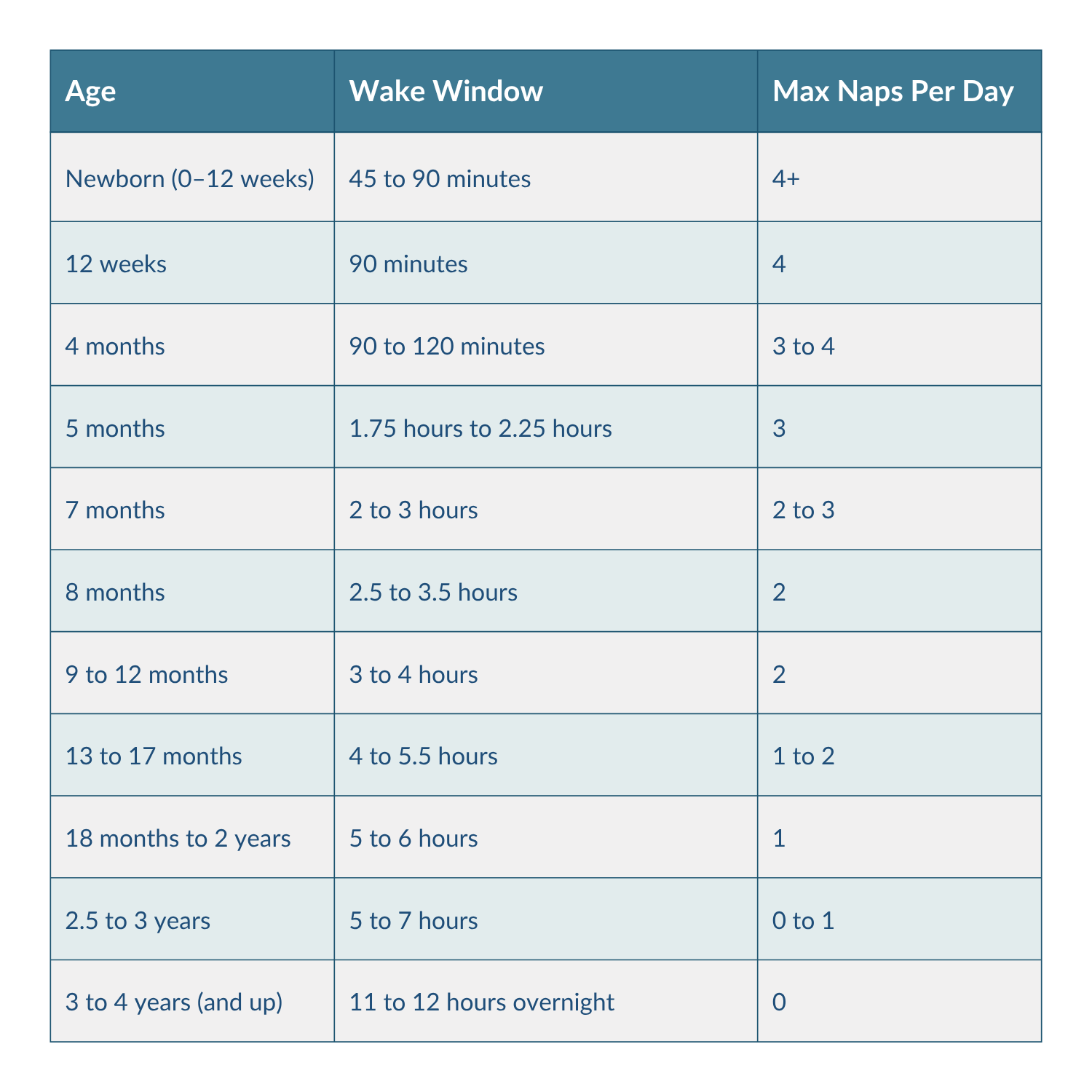
Before you screenshot this chart, check out our free downloadable Sleep Needs By Age Guide. It’s designed to be printed and live on your fridge for easy reference!
How to Read Your Child’s Sleep Cues
Wake windows work best when you pair them with observation. The goal is not to watch the clock and put your child down at the exact minute a wake window ends. The goal is to use the window as a frame, then watch your child for the cues that tell you the timing is right.
Early sleep cues to watch for include:
Yawning (often the first reliable signal)
Staring off or zoning out
Reduced engagement with toys or people
Eye rubbing or ear pulling
Fussiness that does not have another clear cause
If you are seeing these cues toward the earlier end of the wake window, your child may need a slightly shorter window that day. If they are still engaged and happy at the later end, they may be able to handle a bit more awake time. Your child isn’t a robot, so allow for some variation day to day.
REMEMBER: Sometimes parents confuse sleepy cues and think their baby is overtired where in actuality they are just bored. Before jumping to your naptime routine consider changing up the scenery or getting your little on outside for some fresh air.
Age-by-Age Wake Window Guidance
While the table above gives you a quick reference, each age range comes with its own nuances. Here is what to keep in mind as your child moves through each stage.
Newborns (0 to 6 Weeks)
Newborn wake windows are very short, sometimes as little as 45 minutes from the moment they wake. Many parents are surprised by how little time this leaves for feeding, a diaper change, and any brief interaction before it is time to wind back down. At this stage the goal is not a schedule. It is responding to cues, and finding a daily rhythm that works,
Speaking of rhythm, we’ve got a complimentary newborn sleep schedule for you!
2 to 4 Months
Wake windows begin to lengthen, and you will likely start to see more predictability in your baby’s patterns. This is also when the 4 month sleep regression often occurs, which is a sign that sleep is maturing rather than something going wrong. Nap counts remain high at this stage, typically three to four per day.
Get our full 4 month schedule for easy reference!
5 to 7 Months
This is one of the most talked-about periods for wake windows because it is when the two-nap schedule typically establishes itself. The shift from three naps to two usually happens between 5 and 7 months, and wake windows extend meaningfully during this stretch.
The third nap is often the first to go. Signs your baby is ready to drop it include taking longer to fall asleep for that nap, fighting it entirely, or the nap pushing bedtime too late to be sustainable.
Our 4-7 month schedule bundle breaks down the daily schedule for each of these months.
8 to 9 Months
This is a big milestone! Moving to two naps can feel like a relief for everyone, opening up more breathing room in your day and longer stretches to enjoy your baby.
At this age, total daytime sleep should be capped around 3 hours to help preserve 11 hours overnight. Try to anchor naps and avoid shifting them too much day to day. Bedtime may get a little earlier during the transition from three naps to two, and that is normal.
Download the full 8–9 month schedule to start this transition on solid footing.
10 to 14 Months
By 10 months old, you’ve made it through a lot of sleep needs changes and schedule tweaks. Sleep needs tend to level off quite a bit at this age and the hope is that you are on a predictable schedule with consistent naps and overnights. At this age, we want to cap daytime sleep at 2.5 hours and ensure we are giving ample awake time of about 4 hours at the end of the day to build sleep pressure for the night ahead!
Our advanced two nap schedule breaks down three schedule options for naps. The two-to-one nap transition is right around the corner!
18 Months to 3 Years
One solid midday nap is the norm for most of this age range, with wake windows long enough that the day has real structure. Bedtime typically falls between 7:00 and 8:00 PM depending on nap timing and wake time. Nap dropping, which usually happens between 2.5 and 4 years, is not always a clean transition. Many children go through a phase of needing a nap some days but not others.
Our quiet time ideas post covers how to use that window productively while protecting overnight sleep.
Common Wake Window Mistakes
Even with the best intentions, a few patterns tend to trip parents up when they are first working with wake windows. Here is what to watch for:
Using wake windows as a rigid schedule. They are a guide. Build in flexibility based on what you are observing.
Ignoring cues in favor of the clock. If your baby is clearly tired 20 minutes before the window ends, respond to them rather than holding out.
Assuming wake windows fix all sleep struggles. Timing matters, but sleep onset associations and schedule consistency also play significant roles.
Not adjusting as your child grows. Wake windows extend gradually. What worked at 4 months needs revisiting at 6 months.
Applying the same wake window to every day. A disrupted or missed nap changes things. On those days, shorten the following wake window and consider an earlier bedtime rather than holding a typical schedule.
Final Thoughts

Wake windows are one piece of the sleep puzzle, but they work best in combination with a consistent sleep environment and a child who has the skills to fall asleep independently.
In the end, your child’s ability to fall asleep independently is what will create that consistent, reliable sleep we all hope for! If you’re looking to build that skill, you’ve come to the right place.Schedule a complimentary consultation to talk through your child’s full sleep picture and build a plan that makes sense for your family.
Meg O'Leary is an Infant and Child Sleep Expert and the founder of A Restful Night. Based in Westchester County, NY, she leads a team of certified sleep coaches to provide virtual support to families across the US and around the world.