12-Month-Old Sleep: Schedules, Regressions, Nap Transitions & What to Expect
One full year—you’ve done it! This milestone is absolutely worth celebrating. Caring for a baby through their first year is no small feat… 365 days of learning, responding, adapting, and growing together.
In the last 12 months, your baby has transformed in ways that once felt impossible. These days, they may be pulling to stand, cruising along furniture, or even taking their first steps. They’re starting to say a few words, understanding far more than they can communicate, and showing off a personality that is entirely their own.
And just when it feels like you’ve found your rhythm… something shifts again.
That’s especially true when it comes to sleep.
Around the one-year mark, many families notice changes in schedules, resistance at naps or bedtime, and even what feels like a “regression.” The reality? Your baby is growing, developing, and getting ready for the next big transition.
Let’s walk through what’s normal at 12 months and how you can support strong, healthy sleep as you head into year two.

How Much Sleep Does a 12-Month-Old Need?
At 12 months old, most babies need between 13-14 hours of total sleep in a 24-hour period. Ideally, overnight sleep typically accounts for 11 to 12 of those hours, with the remainder coming from daytime naps.Most one-year-olds are still on two naps, but this is also the window when some babies begin showing signs of readiness for the transition to one nap. It can be hard to know which side of that line your child is on, which is something we will get into below:
Sample Sleep Schedules for a 12-Month-Old
Two-Nap Schedule
If your baby is still comfortably taking two naps, there is no need to rush a transition. A well-rested baby on two naps is a baby who is not yet ready to drop one. A typical two-nap schedule at 12 months might look like this:
Wake time: 7:00 a.m.
Morning Nap: 10:00 a.m.
Afternoon Nap: 2:30 p.m.
Bedtime: 7:45 p.m.
Of course, your schedule needs to suit your life! Naps can be equal length, or one can be longer than the other. For a more detailed look at the two-nap schedule, download our advanced two-nap schedule as a starting reference.
One-Nap Schedule
If your baby is showing consistent signs of readiness, the one-nap schedule at 12 months might look like this:
Wake time: 7:00 a.m.
Nap: 12:30 p.m. (1.5 to 2.5 hours)
Bedtime: 6:30 to 8:00 p.m. (depending on the length of the nap).
Download our one-nap schedule for a full picture of how the day can flow.
The 2-to-1 Nap Transition at 12 Months
The 2-to-1 nap transition is one of the bigger schedule shifts in the first two years, and 12 months is on the earlier end of when it typically happens. Most babies make this transition somewhere between 13 and 18 months, so if your one-year-old is still happily taking two naps, that is completely normal.
Signs your baby may be ready to transition include:
Consistently resisting one of their naps for two weeks
Taking a long time to fall asleep at nap time despite being on a solid schedule
Sleeping well at night and waking rested, suggesting they are getting enough overnight
Naps that were previously reliable suddenly becoming short or skipped altogether
Signs your baby is not yet ready include:
Falling asleep easily and sleeping well for both naps
Becoming overtired or difficult at bedtime without a second nap
Night wakings or early mornings that improve when the second nap is reinstated
The transition itself is gradual, not an overnight switch. Expect two to four weeks of schedule adjustment as your baby builds the stamina for a longer wake window.
Separation Awareness at Bedtime
Around 12 months, many babies become more aware of separation from their caregivers. You may notice your baby reaching for you when you put them down, becoming more vocal when you leave the room, or waking overnight and calling out in a way they did not before.
This is a developmental milestone, not a sleep problem. Your baby is cognitively aware enough now to know that you exist when they cannot see you, and that awareness can make separations feel bigger than they did before. It is a sign of healthy attachment, and it does pass.
The most effective way to support your baby through this phase while protecting sleep is to keep your bedtime routine consistent and predictable. A reliable sequence of events, the same steps in the same order every night, signals to your baby that everything is safe and normal, even when you are not in the room.
REMEMBER: Brief, warm goodbyes followed by confident departures are more reassuring than prolonged, hesitant ones.
If your baby is not yet falling asleep independently, separation awareness at this age can amplify those challenges. A baby who relies on your presence to fall asleep will need that presence more urgently now. Building independent sleep skills during this window, rather than waiting for the awareness to pass, tends to produce faster and more lasting results (we can help you with that!).
The 12-Month Sleep Regression
The 12-month regression is real, and it tends to catch parents off guard because things may have been going smoothly. Here is what drives it and what to do about it:
What Is Happening
At 12 months, babies are hitting a significant developmental leap. They are pulling to stand, cruising along furniture, and some are taking their first steps. They are saying first words, understanding more language, and becoming increasingly aware of the world around them. All of that cognitive and physical excitement does not turn off at bedtime.
Common signs of the 12-month regression include:
Nap resistance, sometimes appearing as readiness for the 2-to-1 transition even when it is too early
Night wakings from teething, developmental practice, or general restlessnessIncreased protest at bedtime from a baby who was previously going down easily
Early morning wake-ups as the sleep architecture shifts with new development
How to Handle the 12 Month Sleep Regression
The most important thing you can do during a regression is hold your routine steady. Consistency is what helps your baby adjust.

Keep your bedtime routine intact. Same steps, same order, same time. Resist the urge to add extra steps or extend the routine to compensate for the fussiness. It tends to make things harder, not easier.
Protect the sleep environment. Review the basics: a dark room, consistent white noise, and a comfortable temperature. If teething is a factor, talk to your pediatrician about appropriate relief options before bed.
Avoid creating new sleep associations. It is tempting to respond to night wakings with feeding, rocking, or bringing your baby into bed. In the short term this feels like a solution, but it often extends the regression by building new habits that then need to be undone.
Give it time. Most regressions at this age run two to four weeks. If sleep disruptions are lasting longer than that, it is worth looking at whether there is a schedule or skill issue underneath the developmental noise.
Final Thoughts
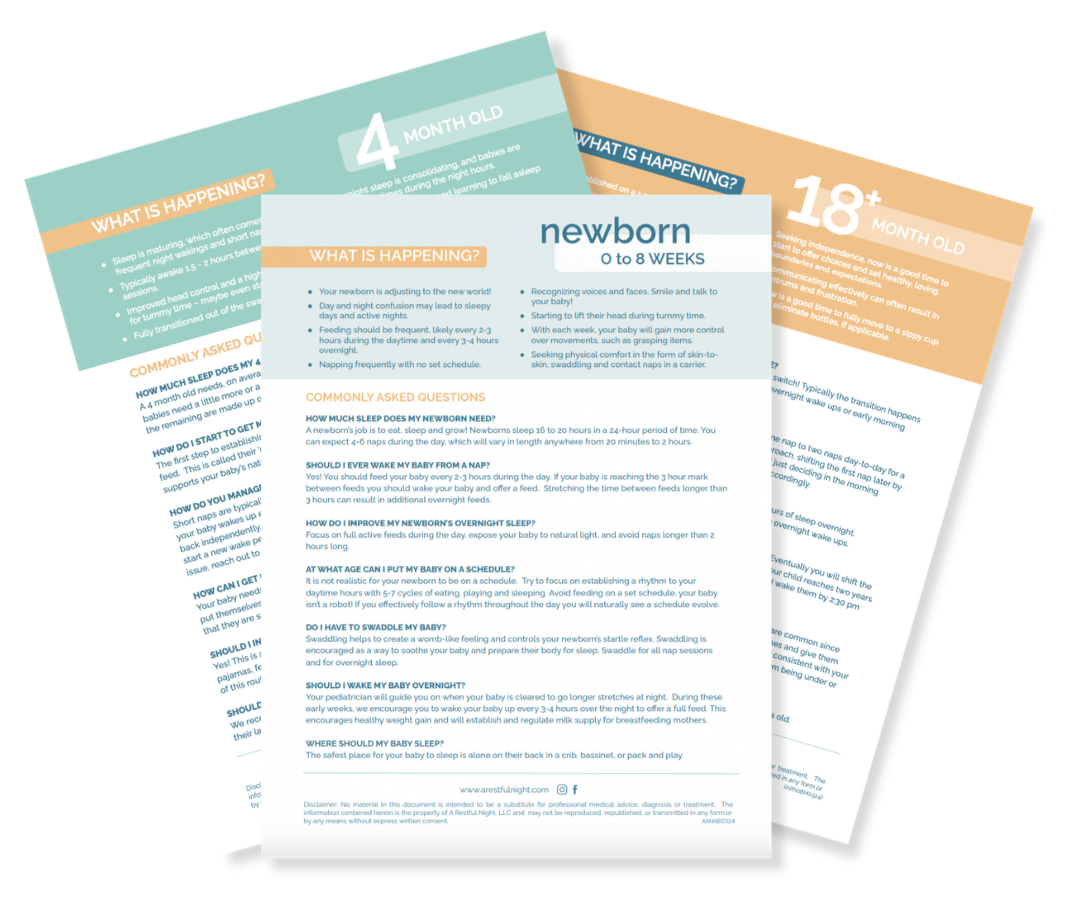
We’ve got a sleep schedule for any age!
The first year is behind you, and the second year comes with its own sleep developments. The 2-to-1 nap transition will fully resolve. Bedtime routines become more interactive and conversational as language develops. Toddlerhood brings its own challenges, including the independence that can fuel bedtime battles, but it also brings a child who can understand more, communicate more, and respond to structure in a way that babies cannot.
The foundation you build now carries forward. If you are heading into the second year feeling uncertain about where your baby's sleep stands, book a complimentary consultation call and we can make sure you are set up well for what comes next.
Meg O'Leary is an Infant and Child Sleep Expert and the founder of A Restful Night. Based in Westchester County, NY, she leads a team of certified sleep coaches to provide virtual support to families across the US and around the world.